Alternate PL- Call to Action
- Guadalupe

- Oct 31, 2025
- 3 min read
Updated: Nov 3, 2025
Learning Without Borders: Redefining Professional Growth Across Disciplines
Hi everyone, my name is Guadalupe Marín, and I’m excited to share the story behind my presentation, Learning Without Borders: Redefining Professional Growth Across Disciplines.
This project grew out of a question that’s been on my mind for years as both a teacher and a learner: Why does most professional learning still look so different from how we want students to learn?
The Why
Like many educators, I’ve sat through countless professional development sessions where we listen, take notes, and leave inspired, but without the time or support to apply anything new. I wanted to challenge that. My motivation came from my own experiences in the classroom and in graduate courses, where I’ve seen how collaboration, creativity, and reflection can completely change how teachers grow.
I also noticed that, across disciplines, whether it’s Spanish, English, or Science, teachers face the same frustration: PD that’s too generic or disconnected from what actually happens with students. Learning Without Borders became my way of proposing a new vision one where professional learning mirrors the process of student learning: it’s active, ongoing, and grounded in real practice.
This idea also connects to a bigger social goal. Education is evolving fast, with AI tools, digital storytelling, and global communication—and our professional learning has to evolve with it. I wanted to show how interdisciplinary collaboration can help teachers adapt, share, and lead together.
The What
The media piece I created is a professional presentation titled “Learning Without Borders.” It highlights the five key principles of effective professional learning: extended duration, ongoing support, active engagement, leader modeling, and subject-specific relevance.
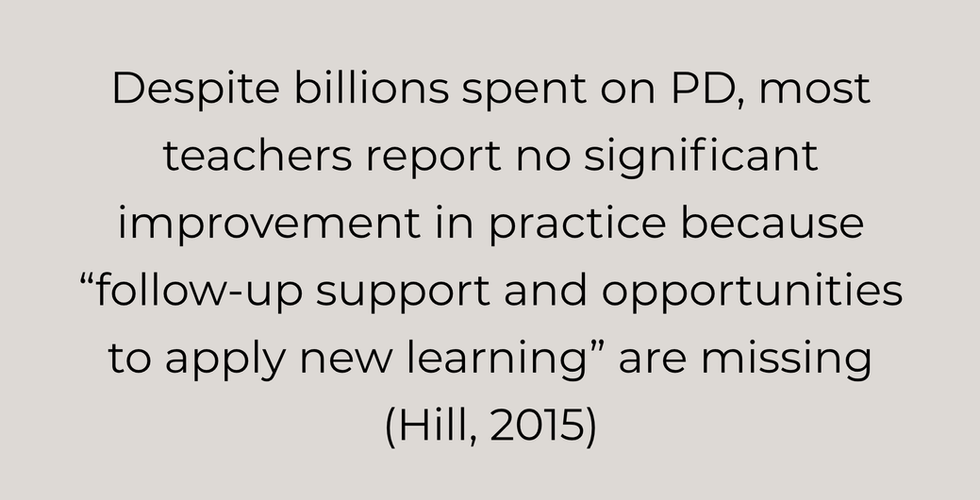
Through visuals, quotes, and original charts, I illustrate how traditional “sit-and-get” sessions often fail to create real growth, while sustained, collaborative PD can make a measurable impact. I also included examples from my own innovation plan like digital storytelling for Spanish teachers and AI-based conversation simulations that can easily be adapted across subjects.
In the presentation, I wanted to move beyond theory and show how these ideas look in action—teachers co-creating lessons, reflecting on practice, and sharing across departments. The goal is simple: to make professional learning as dynamic and creative as the classrooms we want for our students.
The How
To build the presentation, I used Canva and PowerPoint to combine visuals, data, and narrative into one cohesive story. I applied design principles from Nancy Duarte’s book Resonate to keep the visuals simple, clear, and emotionally engaging.
The color palette—blue, coral, and white—was chosen to represent openness,
creativity, and collaboration. I designed all charts manually using real data adapted from research by Gulamhussein, Hill, Desimone and Garet, and TNTP. The data helped me emphasize the contrast between short, one time PD sessions and the lasting impact of continuous, supported learning.
During editing, I paid special attention to pacing, balancing facts, visuals, and personal reflection, so the presentation feels inspiring, not overwhelming. I also added APA-style references and credits for all media used, to maintain academic integrity and model good digital citizenship.
This process reminded me that creativity in education isn’t just about what happens with students, it’s also about how teachers learn, share, and grow. The design process itself became part of my learning: I experimented with visual storytelling, integrated AI tools for drafting, and revised until the message felt authentic to my teaching philosophy.
Closing
In the end, Learning Without Borders is more than a presentation, it’s a call to action. It challenges us to see professional learning as something alive, evolving, and shared. When teachers learn through collaboration and creativity, students feel that energy too.
Thank you for reading and for joining me in reimagining what professional growth can look like when we break down the borders between disciplines, tools, and ideas.
PowerPoint:













Resources:
Daniels, E. (2014). Teacher-driven professional development. Educational Leadership, 71(8), 37–41.
Duarte, N. (2010). Resonate: Present visual stories that transform audiences. Wiley.
Gulamhussein, A. (2013). Teaching the teachers: Effective professional development in an era of high stakes accountability. Center for Public Education.
Hill, H. (2015). Review of The Mirage: Confronting the hard truth about our quest for teacher development.
Comments